
· by Michael Blair, Nashville's Foundation Repair
Plenty of Middle Tennessee houses sit on crawl spaces, but the ones with basements, often on hillsides and in older neighborhoods, share a weak point: a block or poured wall with soil packed against one side of it. When that soil stays wet, the load on the wall goes up, and a wall that was never built for it can start to lean in. The movement is slow and easy to live beside for years. Caught early, a bowing wall is one of the more repairable things we see, and the further it has moved before we get to it, the bigger the repair we will recommend.
What are the signs of a bowing basement wall?
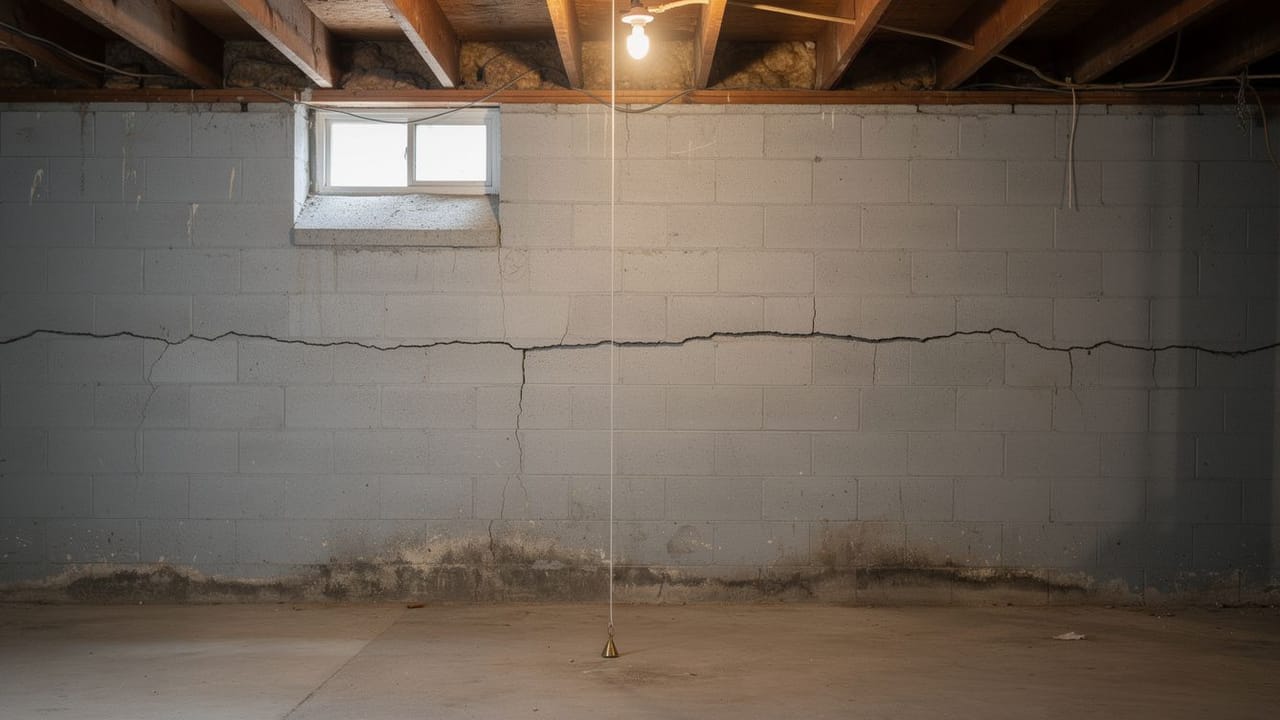
On a block wall, the sign we look for first is a horizontal crack along a mortar joint, often in the upper part of the wall, sometimes with stair-step cracks running down from each end and the block above it leaning in. On a poured wall we look for diagonal cracking from a corner and a bulge across the face instead of a hinge at one joint. You can see the bow yourself: hold a long straightedge against the wall, or hang a string from the top, and the gap at the crack is how far it has moved.
How much bow reinforcement can still hold is a call an engineer makes for your wall, and we would rather measure it than guess. The further the wall has gone, the shorter the list of repairs we will put on it, and block that has begun to shear is past reinforcing. Measure it, photograph it, date the photos and measure again in spring; how fast it is moving matters as much as how far, and our post on tracking a crack through the year sets out how to keep that record.
Why do basement walls bow?
The push comes from the soil and the water in it. The DOE’s Building America guide to footing drains warns that water allowed to collect around a foundation will eventually lead to unacceptable levels of soil saturation, and its guide to gutters and downspouts gives the reason for carrying roof water away as reducing the chances of saturating the soil around the foundation. Some clays also swell as they take on water; the USGS published a swelling clays map of the conterminous United States in 1989, and our post on Middle Tennessee clay covers what it does under a house.
Outside a bowing wall, we look for whatever is adding water: a downspout dumping at the corner, grading that falls toward the house, a window well that fills and holds water, a driveway that sheets rain at the wall. An older block wall may have no reinforcing steel in it at all, since it was built to carry the house above, and holding back wet soil is a different load. When a wall that stood fine for decades starts to bow, the first question we ask is what changed outside it: a new patio, a loose downspout, a regraded bed, or a run of wet years.
The repairs, from least to most
On a wall that has bowed only slightly and is otherwise sound, we use carbon fiber straps: bands epoxied to the wall vertically and anchored at the top and bottom. They are there to hold the wall where it is, and they take up almost no room in the basement. They won’t pull it back.
A wall that has gone further gets steel beams or wall anchors. A beam stands against the wall, fixed to the floor slab and to the framing above, and some beam systems can be tightened in steps to ease the wall back. A wall anchor runs a rod through the wall to a plate buried out in the yard and is tightened from inside; it needs room in the yard and soil that will hold the plate, and any straightening it does is gradual, across seasons. A wall that has moved too far for any of these is dug out and rebuilt, the most disruptive and most expensive option. Our page on bowing and cracked walls covers anchors and carbon fiber in more detail.
- Slight bow, wall still sound: carbon fiber straps
- More movement: steel beams or wall anchors
- Severe bow or sheared block: dig out and rebuild
- Every option: fix the water behind the wall
What has to happen alongside the repair
We don’t put a strap, beam or anchor on a wall without dealing with the water behind it too. Downspouts come first: the DOE’s gutters and downspouts guide has them end at least 5 feet from the foundation, or feed an underground catchment at least 10 feet away, with the pipe pitched at least 5/8 inch per foot, and it says a daylight drain should empty onto a grade that slopes away from the building. Grading that falls toward the house gets corrected, and a window well that holds water gets a drain.
Where the lot or the water table makes that not enough, a drain tile along the footings, outside or inside, carries water off to daylight or to a sump pump, as the Building America footing drain guide describes; that is the work on our basement waterproofing page. If a quote for the wall leaves the water out, ask why.
Keep the paperwork as well. If the house sells later, a buyer will want to know what happened to that wall, and what answers them is the record: the measurements, the dated photos, any engineer’s report, the scope of the repair and whether the warranty transfers. A crack painted over hides that record along with the crack. Don’t count on insurance for the bill either: the Tennessee Department of Commerce and Insurance points homeowners to the NAIC’s consumer guide, which says a homeowners policy isn’t a maintenance contract and doesn’t pay to repair things that simply wear out. Our post on insurance and foundation movement goes further, and if you’d like the wall measured before the next wet season, ask us for a free estimate.
Sources
- U.S. Department of Energy, Building America Solution Center, Footing Drain Pipe (updated 2017) — Water collecting around a foundation leads to soil saturation; drain tile along the exterior or interior of the footings, discharging to daylight or a sump pump
- U.S. Department of Energy, Building America Solution Center, Gutters and Downspouts (updated 2021) — Carrying roof water away reduces saturation of the soil around the foundation; downspouts end at least 5 feet out or at a catchment at least 10 feet away; pipe pitched at least 5/8 inch per foot; daylight drain onto a grade sloping away
- U.S. Geological Survey, Swelling clays map of the conterminous United States (I-1940, 1989) — The national swelling clays map and its 1989 date
- Tennessee Department of Commerce and Insurance, Homeowners and Automotive Insurance Information — Links the NAIC consumer guide to homeowners insurance, which says a policy is not a maintenance contract and does not pay for things that wear out
FAQ
Bowing Basement Walls and What Holds Them — questions
Is a bowing basement wall an emergency?
It depends on how fast it is moving, which is why we measure it. A wall that reads the same twice, months apart, gives you time to plan; one where the crack is opening week to week needs someone out soon. Either way, the list of repairs gets shorter as a wall moves, so get a plan in place before the next wet season.
Can a bowing wall be straightened?
Sometimes. Wall anchors and some adjustable beam systems are tightened in steps to ease a wall back gradually. Carbon fiber straps hold a wall where it is and do not move it. A wall whose block has sheared is rebuilt, not straightened.
Does homeowners insurance cover a bowing basement wall?
Don’t count on it. The consumer guide that Tennessee’s insurance regulator links to says a homeowners policy is not a maintenance contract and does not pay to repair things that simply wear out. Policies differ, so read the earth movement and water exclusions in yours, and plan on paying for the repair yourself unless the policy says otherwise. That is one more reason to deal with a wall while the repair is still reinforcement and not a rebuild.
How do you fix a bowing foundation wall?
It depends on how far the wall has moved. A slight bow in a sound wall gets carbon fiber straps that hold it in place; more movement calls for steel beams or wall anchors, some of which can ease it back over time; sheared block means rebuilding. Every option includes fixing the water behind the wall.