
· by Michael Blair, Nashville's Foundation Repair
When a Middle Tennessee house moves, the first thing we ask about is the ground under it and how wet or dry that ground gets through the year. Where the soil is clay, the picture we work from is simple: clay that takes on water swells, clay that gives it up shrinks, and a foundation resting on it rides those changes up and down with the seasons. Nashville’s weather supplies plenty of both, with a normal of 50.51 inches of rain a year and normal highs above 90°F in July and August, going by the climate figures NOAA’s Nashville forecast office publishes.
The mechanism
Our understanding of it goes like this. Wet clay expands and can press up under a slab or in against a wall. Dry clay shrinks and can pull back, leaving a footing with less soil bearing on it than it had in spring. Nothing about a house makes that happen evenly, and the rain doesn’t arrive evenly either: the forecast office’s monthly normals run from 5.02 inches in May down to 3.36 in October, and Nashville averages 49 days a year at 90°F or hotter, 41 of them in June, July and August.
It’s the difference from one side of a house to the other that we worry about. A house whose north wall stays damp in shade while the south wall bakes all afternoon is one we’d expect to move unevenly, and uneven movement is what we think cracks brick, drywall and slabs. Clay isn’t the only suspect here, though. The Tennessee Geological Survey’s mapping program includes information about geologic hazards such as caves, landslides and sinkholes, so when a pattern of cracks doesn’t follow the seasons we want the house inspected and measured before anyone talks about a repair.
Why is drainage the main fix for clay soil?
Of everything an owner controls, keeping soil moisture as even as possible around the perimeter is where we would start. In practice that means moving roof water away from the house and shaping the ground so runoff can’t pond against the wall, which is what our regrading and drainage work is for.
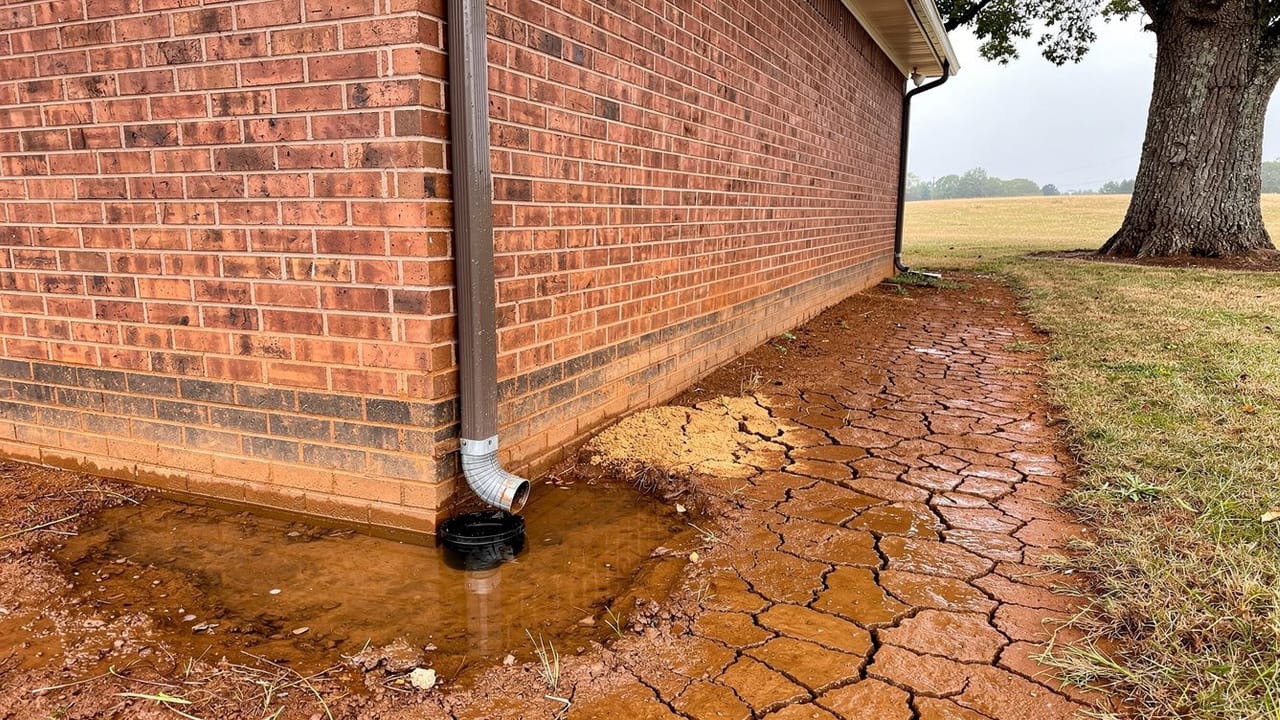
Downspouts emptying right beside the foundation are the first thing we check. At Nashville’s normal of 50.51 inches a year, each square foot of roof sheds roughly 31 gallons of rain annually by our arithmetic, so the stretch of roof feeding one downspout can put thousands of gallons a year onto a single patch of clay. The EPA’s guidance on disconnecting and redirecting downspouts suggests sending that water to a rain barrel or to a lawn or garden where it can soak in, and tells owners to consider where it will end up so it doesn’t cause property damage. Beside a foundation on clay is the spot we least want it.
- Downspouts carried well out from the wall, or piped away
- Ground that falls away from the house on every side
- Gutters kept clear so they do not overflow at the wall
- No beds that hold water against the foundation
- Steady watering in a drought, not none and then a lot
Trees and drought
When one side of a house has dropped, a big tree standing close to that side is among the first things we look for. Our working assumption is that a large tree pulls a lot of water out of the clay in summer, more on its own side of the house than anywhere else, and that local drying is exactly the uneven change described above.
We’d expect the opposite after a mature tree near the house is cut down: the clay it had been drying can take water back on and swell. Either change would come on slowly, over seasons, which is why owners tend to miss it until a door starts sticking that never used to.
Should you water a foundation on clay in a drought?
In a long dry spell we sometimes suggest a soaker hose laid a foot or two back from the wall, so the clay beside the footing doesn’t dry back from it entirely. We haven’t found a published standard for this, so treat the distance and the method as our own practice, and it’s only for a house that already shifts with the time of year. Our post on watering a foundation in a dry summer walks through the setup and the cases where it does more harm than good.
What we’re after is steady moisture, not more of it. Swinging from bone dry to saturated and back strikes us as worse than either one held steady, so short regular runs make more sense to us than an occasional soak. If you’d like someone to look at how the ground around your house is behaving, ask us for an estimate.
Sources
- NOAA National Weather Service, Nashville Climate Records — Annual normal precipitation 50.51 in.; monthly normals from 3.36 in. (October) to 5.02 in. (May); normal highs 90.9°F in July and 90.4°F in August; on average 49 days a year at 90°F or above, 10 in June, 17 in July and 14 in August
- U.S. EPA, Soak Up the Rain: Disconnect / Redirect Downspouts — Redirect downspouts to a rain barrel, lawn or garden where water can soak in; consider where the water will be directed to avoid property damage
- Tennessee Department of Environment and Conservation, Tennessee Geological Survey: Geology Programs — The survey’s geologic mapping includes information about geologic hazards such as caves, landslides and sinkholes
FAQ
What Middle Tennessee Clay Does to a Foundation — questions
Should I water my foundation in a drought?
Sometimes, and with care. We suggest it only for houses that already move with the seasons: a soaker hose kept a foot or two off the wall on every side, run lightly and often. That is our own practice rather than a published standard. The aim is to keep the clay from drying back from the footing, and we would fix any drainage problem before adding water beside a house.
Do trees cause foundation problems?
They can play a part. A large tree near the house draws water out of the soil in summer, and we look for one whenever a single corner has dropped. We would also expect clay to take water back on and swell after a mature tree close to the house is removed. Neither is a reason to avoid trees; we would just plant the big ones well away from the foundation.
What is the single best thing I can do for my foundation?
Manage water. Carry downspouts well away from the house, keep gutters clear, and keep the ground falling away from the foundation. Many of the foundation problems we see in Middle Tennessee come back to moisture in clay, though not all of them, and roof water landing beside a wall is usually the simplest place to start.
Why is clay bad for foundations?
It changes size with its water content. Wet clay swells and can press up under a slab or in against a wall; dry clay shrinks and can leave a footing with less soil bearing on it. When one side of a house wets or dries faster than another, the uneven movement is what we think cracks brick, drywall and slabs.