
· by Michael Blair, Nashville's Foundation Repair
Every dry summer someone asks us whether they should run a hose along the foundation, and this year gave them reason to: drought.gov’s Tennessee drought page ranks January through August 2026 as the 23rd driest such stretch on record since 1895, 3.99 inches below normal, and by the second week of October it showed about 60.6 percent of the state in drought. The point of watering is to keep the soil beside and under the footing from drying much more in one place than another, on houses where we think that drying is what moves them. We cover the soil itself in what Middle Tennessee clay does to a foundation; this post is the narrower question of whether a soaker hose helps, and how to run one without making things worse.
What the watering is actually for
The goal is not to wet the foundation. We want the soil around and under the footing to sit at roughly the same moisture all through the dry months, so it isn’t baked in August and then soaked when the fall rain comes back. Steady is what we’re after. We would much rather a house sat on soil that changes slowly than on soil that goes from dust to mud over one weekend, and timing matters, because drought.gov notes that drought in the Southeast can set in fast when a lack of rain and high temperatures arrive together.
We only suggest it for houses whose movement already follows the calendar: doors that stick in late summer and free up by winter, a crack that opens and closes with the year. Those are the houses where we suspect moisture is the driver, and where managing it might do something. If you aren’t sure yours is one of them, tracking the crack through a full year is how we would find out before spending anything.
How to do it
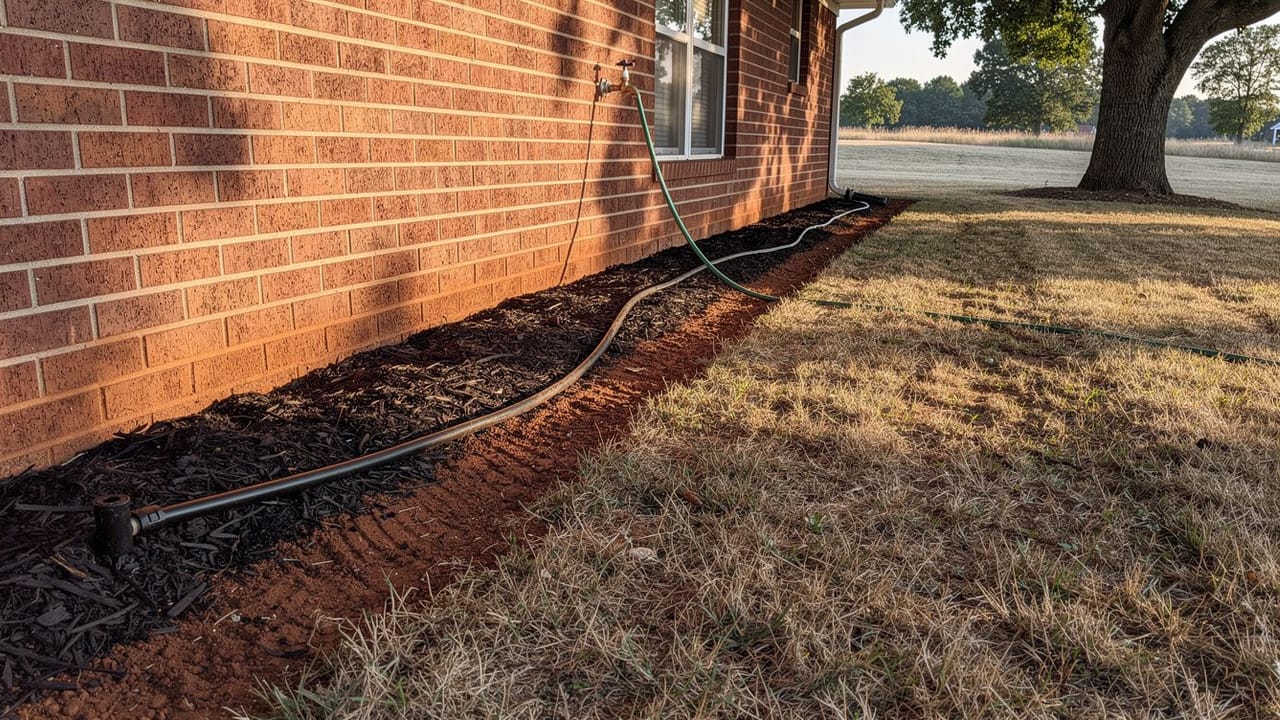
This is how we set it up when we recommend it. It is our own practice; we haven’t found a published standard that gives a distance or a schedule. A soaker hose goes on the ground a foot or two out from the foundation, not against it, on a timer that runs it for a modest stretch in the early morning a few times a week through dry spells. We want the surface damp, never muddy, and never any water standing against the wall. We lay mulch over the hose to keep the wetting even along its length.
We would start in early summer, before the ground has cracked, rather than try to rewet baked clay in August. Our worry with a gap that has already opened is that water poured into it runs down to the footing in one spot and wets the soil under it unevenly, which is the opposite of what the hose is there to do. Keep an eye on that strip of soil by the wall; the hope is that the gap never shows up at all.
- Soaker hose a foot or two out from the wall, all the way around
- Timer, early morning, short runs, several times a week when dry
- Damp soil, not wet; no standing water at the wall
- Start in early summer, before the clay cracks
When does watering a foundation make things worse?
We don’t add water beside a house that already has a drainage problem. If the grade slopes toward the house, if downspouts empty at the foundation, or if the crawl space or basement already takes water, a soaker hose is the last thing we would suggest; we would sort out the drainage first and only then come back to the watering question.
Watering one side only is the other mistake we see. Wet soil on the hose side and dry soil on the other is exactly the uneven moisture the whole exercise is meant to avoid, so if you can’t run it all the way around, we would leave it off. And when a foundation is moving for some other reason, such as poor fill, a broken drain line under the slab or a footing that was too small for the house, we wouldn’t expect any amount of watering to help.
How do trees affect a foundation in a drought?
Big trees close to the house draw water out of the soil, and drought.gov counts transpiration from plants, along with evaporation from the soil, in the evapotranspiration that rises with warmer air and lowers soil moisture. When one corner of a house moves more than the rest, we check early for a mature tree standing near it. A hose may simply not keep up with an oak. The choices we put to owners are a root barrier, or accepting that the tree side needs more water than the rest of the house.
If a house has needed watering to stay still for several summers running, we would call that a maintenance routine rather than a fix, and it is worth having the foundation inspected and measured properly. When we pier a house, the aim is to carry its weight down past the soil that changes with the seasons, so it no longer depends on the hose. Pier work is structural, so ask whoever quotes it about permits; Metro Nashville Codes has registered contractors apply for building permits through its online ePermits system, and its site has a property permit history search for checking an address. If you would like us to tell you which kind of house yours is, ask us for an estimate.
Sources
- NOAA National Integrated Drought Information System, Drought.gov: Tennessee — January to August 2026 the 23rd driest on record since 1895, 3.99 in. below normal; about 60.6% of the state in drought (data week of Oct. 6 to 12, 2026); Southeast droughts can develop rapidly with heat and no rain; warmer air raises evapotranspiration (soil evaporation plus plant transpiration) and lowers soil moisture
- Metro Nashville and Davidson County, Codes and Building Safety — Registered contractors apply for building permits through the ePermits system; property permit history search
FAQ
Should You Water Your Foundation in a Dry Summer — questions
Does watering a foundation actually work?
We suggest it only where a house moves with the seasons and drying soil looks like the cause, and the aim is steady soil moisture rather than extra water. We haven’t found published research we would point you to on how much it helps, so we treat it as a way to manage movement, not a repair. It does nothing for a foundation moving for other reasons, and we never run one beside a drainage problem.
How far from the house should a soaker hose go?
We lay it between one and two feet from the wall, on the surface under mulch, all the way around the house rather than along one side. That distance is our own practice, not a published figure. We keep it off the wall itself so the water isn’t running straight down beside the footing in one place.
When should I start watering my foundation?
We start in early summer, when the dry weather begins and before the soil has pulled away from the house. Once a gap has opened, our concern is that the water runs down it to the footing in one spot instead of wetting the soil evenly.
How do you water a house foundation during a drought?
Lay a soaker hose a foot or two out from the foundation all the way around, cover it with mulch, and run it on a timer for short early-morning stretches a few times a week through dry spells. Keep the soil damp, never muddy, with no water standing at the wall. That is our practice, not a published method.