
· by Michael Blair, Nashville's Foundation Repair
Finding a crack in your foundation is rarely news on its own. University of Minnesota Extension’s guide to basement moisture says concrete and concrete block foundations usually develop some cracks, that settling soil causes cracking, and that the spots where walls meet something rigid, like a fireplace, often crack as well. So the question we ask on a visit is never whether there is a crack. It is which way the crack runs, how wide it has opened, and whether it is still moving.
Are vertical foundation cracks serious?
When a vertical crack in a poured wall is narrow, runs fairly evenly along its length and the two faces still line up, we treat it as a water problem first and a structural one only if it changes. Of the three patterns here, it is the one we worry about least.
Water is what a crack like that costs you. The Minnesota guide notes that a basement pulls moist air in through any crack in the foundation, and it puts gutters, downspouts and grading ahead of anything done to the wall: soil sloped away from the house at least 1 inch per foot for at least 6 feet, and downspout extensions that discharge at least 4 feet out. It also warns that a coating on the inside tends to fail or push the water to another way in. So we deal with the water outside first, usually through our drainage and grading work, and seal the crack afterward if it still needs it.
Horizontal cracks
This is the one we take most seriously. A horizontal crack running along a block or poured basement wall can mean the wall itself is moving, and the Minnesota Extension authors say foundation cracks can be severe when the floor joists are not properly tied to the foundation wall, which lets the wall move. Their fix is a sound connection at the top of the wall: anchor bolts or straps at the sill plate, with the joists nailed to it.
So when we find one, we check the wall for a bow or a lean, look at how the framing sits on the top course, and look at what the soil and water are doing outside. If the wall has bowed at all, we would want it assessed before anyone seals the crack, because filling it hides the movement and does nothing to stop it. What holds a wall like that is the subject of our wall repair page and our post on bowing basement walls.
What does a stair-step crack in block or brick mean?
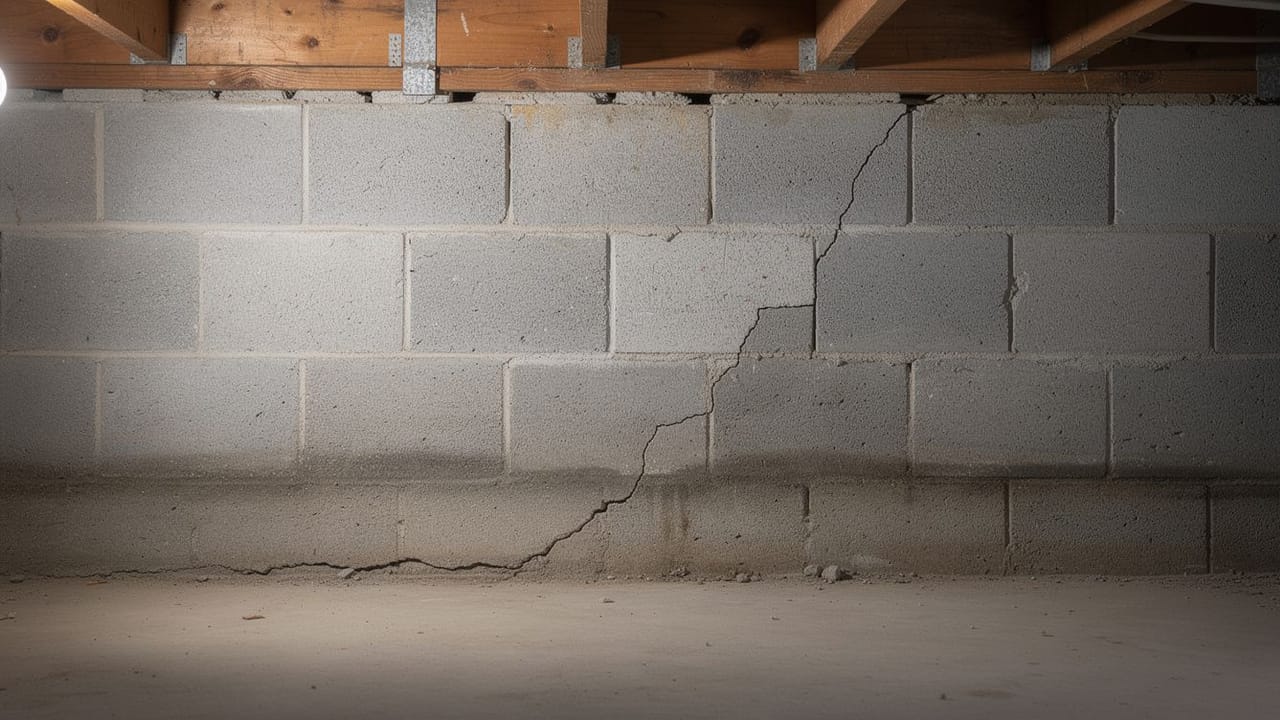
In block and brick, a crack that climbs the mortar joints like a staircase is one we read as possible settlement, where one part of the wall has dropped a little relative to the part beside it. Settling soil is one of the causes of foundation cracking in the Minnesota guide, and the ground here has its own questions: the Tennessee Geological Survey publishes geologic quadrangle maps of the state that include information on hazards such as caves, landslides and sinkholes. When a stair-step crack keeps widening, we want to know what is under that corner before guessing.
Width and offset are what we weigh. A hairline through the mortar that has looked the same for years concerns us far less than a joint that has visibly opened, or a course of block that has slid out of line with the course beneath it. Settlement that is still going on is the work our pier and settlement repair is for.
- Vertical, narrow, faces still aligned: we start with the water outside
- Horizontal, with any bow or lean: assessed before anything is sealed
- Stair-step, with a course out of line: we look for settlement under that section
- Wider at each check: we treat it as active movement
- Cracks plus doors or windows that have started sticking: we look at them together
Monitor before you commit
Before paying for a repair, a record is worth having. Pencil a short line at each end of the crack and date it, measure the width at the widest point, and photograph it from the same spot. Look again in about three months and after the next long wet stretch. Our post on tracking a crack through the year goes through it step by step.
A crack that opens in one season and closes again in the next is behaving very differently from one that only ever gets wider, and we read them differently: the first sends us to the water around the house, the second to what is holding the house up. If your marks show steady widening, or you would rather not wait, ask us to come and look. Whoever you hire, the state’s Board for Licensing Contractors licenses general and home improvement contractors in Tennessee, and its site has a license lookup you can run on any company before work starts.
Sources
- University of Minnesota Extension, Moisture in basements: causes and solutions — Concrete and block foundations usually develop some cracks; settling soil and loose joist connections cause cracking; walls crack at rigid structures; moist air drawn in through cracks; grading 1 inch per foot for 6 feet; downspout extensions 4 feet; interior coatings move the water elsewhere; anchor bolts or straps at the sill plate
- Tennessee Department of Environment and Conservation, Tennessee Geological Survey, Geology Programs — Geologic quadrangle maps of Tennessee include information on hazards such as caves, landslides and sinkholes
- Tennessee Department of Commerce and Insurance, Board for Licensing Contractors — Licenses contractors and home improvement contractors in Tennessee; license verification on the board’s site
FAQ
Which Foundation Cracks Actually Matter — questions
Are foundation cracks normal in Nashville?
Some cracking is normal. Concrete and block foundations usually develop some cracks, and settling soil is a common cause, so a fine crack on its own is not alarming. The ones we would want to see are horizontal cracks, walls that bow or lean, and stair-step cracks where the block has shifted out of line.
How wide does a crack have to be to worry?
There is no single width that settles it. We pay more attention to direction and change than to a number: a narrow horizontal crack in a basement wall concerns us more than a wider vertical one, and any crack where one side has moved past the other, or that is wider each time you check it, is worth having looked at.
Should I get a structural engineer or a foundation company?
For a large repair, an independent structural engineer first is the safer order. The engineer is not selling the repair and can tell you if nothing needs doing, which is worth the fee before you commit. A foundation company can assess it too, and we give free estimates, but a company that does repairs has a reason to find one. Whoever does the work, check their contractor license with the state board before you sign.
Do all foundation cracks need to be repaired?
No. Concrete and block foundations usually develop some cracks, and a narrow vertical one whose faces still line up may need only the water outside dealt with, then sealing if it still needs it. Horizontal cracks with any bow, stair-step cracks with a shifted course, and cracks that keep widening are the ones that may need structural repair.