
· by Michael Blair, Nashville's Foundation Repair
A general home inspector will flag foundation concerns and recommend further evaluation, which is the right call. It isn’t a diagnosis, though. Tennessee’s Standards of Practice for home inspectors define the inspection as a visual examination, and the written report has to say whether a condition needs repair, needs watching or “warrants further investigation by a specialist.” Knowing what to look at yourself helps you decide when to spend on an engineer before the inspection period in your purchase contract runs out.
Outside
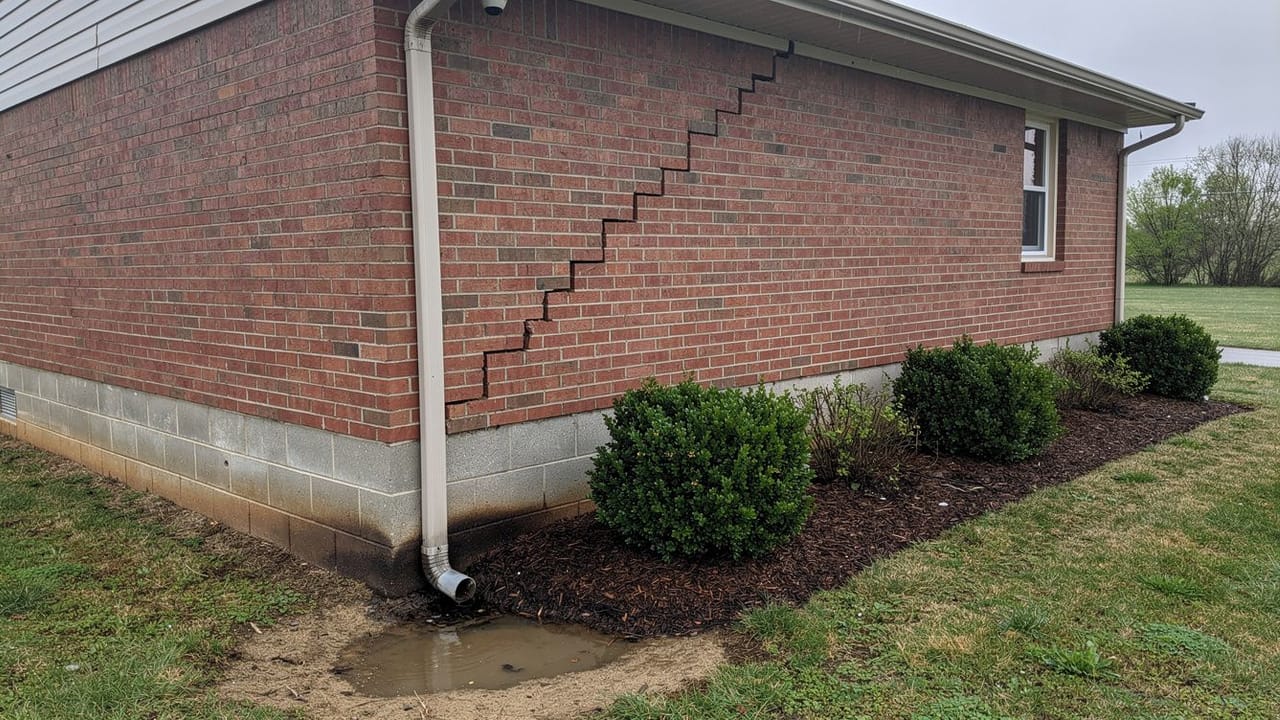
Walk the perimeter. We look for stair-step cracking in brick, particularly near corners and above openings, and for a wall that is out of plumb. On a viewing, take a photograph of each one and note where it is, so you can point the inspector to it later.
Then look at where water goes. The Department of Energy’s Building America guide to sloping the final grade away from a foundation says the site should be graded so water drains away from the house on all sides, gives the ENERGY STAR target for new homes of at least half an inch of fall per foot for the first 10 feet, and advises sending downspout water to an approved location such as a swale or drywell. Downspouts that empty against the wall, soil that tips back toward the house and mulch beds banked up against the brick all work the other way. Tennessee’s inspection rules have the inspector look at grading and drainage for their effect on the building, so read what the report says about them, and our drainage and grading page covers what fixing a bad slope involves.
What foundation signs show up inside a house?
Inside, we look for cracks at the corners of door and window openings, doors that don’t sit square in their frames, and floors that slope consistently in one direction. Each of those can have an ordinary cause, as our post on sticking doors explains. Several of them in the same part of the house is what makes us want a closer look, and floor slope is far easier to judge with numbers, which is why our inspections record measured floor levels.
Fresh paint or new drywall in only one area of an older house is worth a question. It isn’t evidence that anything was hidden, so ask the seller what was repaired, when, by whom, and whether there is paperwork for it.
- Stair-step cracks in brick, especially at corners
- Walls out of plumb
- Doors out of square in their frames
- Consistent floor slope in one direction
- Downspouts and grading at the perimeter
- Crawl space: standing water, rot, failed posts
The crawl space is worth the trouble
If the house sits over a crawl space, that’s the place we would most want to see. The Tennessee standards require the inspector to enter it unless access is obstructed, entry could damage the property or conditions look dangerous, and to report signs of water getting into the building. When the inspector doesn’t go in, the report must list the crawl space as not inspected and give the reason, so look for that line before you rely on the rest.
Standing water, damp or rotted joists, sagging girders and posts that have settled can all be seen with a flashlight. Water deserves attention even where the framing still looks sound: the Building America guide to capillary breaks on crawlspace floors explains that moisture coming up into a crawl space from the ground can lead to mold and the moisture-related failure of building materials.
It also shows whether previous work has been done, and whether it was done well. Extra posts, newer piers or doubled-up joists are worth asking about in the same way fresh drywall upstairs is.
When should a buyer call a structural engineer?
These are the findings where we would want an engineer’s opinion before going further: any horizontal crack, any bowing wall, significant stair-step cracking with displacement, or a combination of interior symptoms. How we read a crack is set out in our post on which foundation cracks matter.
A home inspection isn’t built to settle those questions. Under the same rule, inspectors aren’t required to report the cause of a needed repair or the methods, materials and costs of correcting it, and they aren’t required to calculate the strength or adequacy of any component. An engineer’s report describes the problem and gives you something concrete to negotiate with or walk away from, while a repair quote, ours included, prices one answer to it. Before you book anyone, you can confirm an inspector holds a state license through the Tennessee Home Inspector Licensing Program, which the state created in 2005. If you already have a report and want to know what the repair would involve, send it to us.
Sources
- Tennessee Department of Commerce and Insurance, Rules of the Home Inspectors program, chapter 0780-05-12, rule .10 Standards of Practice (revised January 2026) — Inspection is a visual examination; the report states whether a condition needs repair, observation or further investigation by a specialist; inspectors inspect the foundation, floors, walls and piers, grading and drainage, and must enter crawl spaces or list them as not inspected with the reason; not required to report causes, repair methods or costs, or calculate strength or adequacy
- Tennessee Department of Commerce and Insurance, Tennessee Home Inspector Licensing Program — The program was created in 2005 to regulate home inspectors in Tennessee; license verification
- U.S. DOE Building America Solution Center (PNNL), Final Grade Slopes Away from Foundation — Grade so water drains away from the house on all sides; ENERGY STAR new homes: at least 0.5 inch per foot for 10 feet; direct downspout water to an approved location such as a swale or drywell
- U.S. DOE Building America Solution Center (PNNL), Capillary Break: Crawlspace Floor, Polyethylene Sheeting under Concrete Slab — Moisture coming up into a crawlspace from the ground can lead to mold and moisture-related failure of building materials
FAQ
Checking a Foundation Before You Buy — questions
Does a home inspection cover the foundation?
Yes, visually. In Tennessee the inspector looks at the foundation, floors, walls and piers, and the report has to say whether a condition needs repair, needs watching or warrants further investigation by a specialist, which for a foundation is often a structural engineer. That referral is not a formality. It means the question has not been answered yet, and the inspection period in your purchase contract is the time to answer it.
Should I walk away from a house with foundation issues?
Not automatically. Some findings turn out to be minor and others can be repaired. What matters is knowing the scope and the cost before committing, which means an engineer’s report rather than a contractor’s estimate alone. Unknown scope is the thing to walk away from.
How much does a structural engineer report cost?
Fees vary with the engineer and the house, so ask for the price before you book and ask whether it includes a written report. Book early enough that the report reaches you before your inspection period ends, since a report that arrives after the deadline cannot change what you agreed to.
How can I inspect a foundation myself?
Walk the outside first, looking for stair-step cracks in brick near corners and above openings, walls out of plumb, and downspouts or soil sending water toward the house. Inside, check the corners of door and window openings, doors out of square and floors sloping one way. In a crawl space, a flashlight shows standing water, rotted joists and settled posts.